
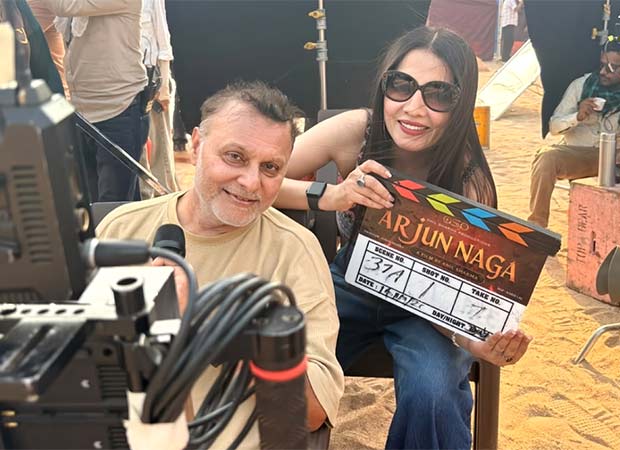
Anil Sharma Plans Four-Part Bollywood Saga ‘Arjun Naga’ Set During Dubai’s 1960s Oil Boom
In an era when filmmakers increasingly plan expansive stories across multiple instalments, Anil Sharma is taking the idea further with Arjun Naga. The filmmaker has announced that his upcoming period drama, led by his son Utkarsh Sharma, is being developed as a four-part film series—a notably ambitious undertaking for Bollywood.
Rather than waiting to see how the first chapter performs before deciding whether to continue, Sharma says the story has been conceived on a much larger scale. Each instalment will have its own title, while contributing to a broader narrative set against a defining period in Dubai’s history. The project is expected to combine a rise-from-poverty story with changing fortunes, political and personal power struggles, and the transformation of a city.

A sweeping story rooted in Dubai’s oil rush
According to a report in Mid-Day, Arjun Naga will unfold during Dubai’s oil boom in the 1960s. The historical backdrop includes the discovery of oil in the Fateh field in 1966, a milestone that helped reshape the emirate’s economic future. Before oil became central to its growth, Dubai was a comparatively modest settlement known for fishing and trade.
The film’s story will begin in this earlier landscape, with dusty roads and simple homes, before charting the changes brought by exploration and the promise of new wealth. A concession for oil exploration was reportedly granted to the Continental Oil Company in 1963, followed by years of drilling before the significant discovery. That period provides the setting for a fictional drama about people whose ambitions and fortunes shift as Dubai itself changes.
A source quoted by Mid-Day described the film as a tale of power dynamics unfolding alongside the emirate’s transformation. Utkarsh Sharma’s character is expected to begin in extreme poverty and rise to become one of the richest men in Dubai. The premise gives the series room to explore not only personal ambition but also how rapid economic change can alter social hierarchies, relationships and access to influence.
Four instalments, a large ensemble and international locations
Anil Sharma has confirmed that the project is planned as a four-part saga. In comments reported by Mid-Day, he said the films will feature between 10 and 12 prominent actors in pivotal roles across the instalments. He also noted that each chapter will have a different title, suggesting that the individual films may focus on distinct stages of the larger story.
The production is expected to shoot across several locations, including Mumbai, Rajasthan, other parts of India, Dubai and additional international cities. The varied settings could help the filmmakers recreate the contrast between Dubai’s earlier, smaller-scale character and the rapid expansion associated with the oil era. Period dramas of this scale often rely on a combination of location work, production design and visual effects to make historical settings feel convincing to modern audiences.
Planning a four-part narrative from the outset is a major commitment. It can allow filmmakers to build characters and historical context gradually, rather than compressing every development into a single film. At the same time, the format places a high bar on continuity: each instalment needs to offer a satisfying experience while giving audiences a reason to follow the story into the next chapter.
Utkarsh Sharma leads a growing cast
Utkarsh Sharma will play the central character, continuing his collaboration with his father, Anil Sharma. The actor is best known for his work in the Gadar franchise, and Arjun Naga gives him a different kind of lead role: a character whose journey is shaped by poverty, opportunity and the pursuit of power.
Arjun Rampal has reportedly been cast as the antagonist, adding another prominent name to the ensemble. Randeep Hooda and Celina Jaitly have also joined the period drama, according to reports. With the story spread across four parts and a large cast planned, the film could give its supporting characters substantial roles in the wider narrative rather than limiting the drama to a single hero-villain conflict.
The music will be composed by Himesh Reshammiya, as exclusively reported by Bollywood Hungama in August 2026. Music may play an important role in establishing the period and emotional tone, particularly in a story that spans changing social and economic conditions. Further details about the complete cast, individual instalment titles and production schedule have not yet been announced.
Bollywood’s expanding appetite for multi-part storytelling
For decades, sequels were often considered only after a film proved successful. That approach has gradually changed, with large-scale projects increasingly designed as connected stories from the beginning. Films such as Baahubali and Pushpa helped demonstrate the commercial and storytelling potential of multi-film narratives. More recently, projects including Dhurandhar and the planned two-part Ramayana have reflected the industry’s willingness to build stories across instalments.
Arjun Naga takes that trend further with its proposed four-film structure. Its historical setting also distinguishes it from many contemporary action franchises. The oil boom offers a backdrop for a story about wealth and social change, while the fictional rise of Utkarsh’s character gives the series a personal thread through which audiences can experience the era.
The project’s success will ultimately depend on how effectively it balances spectacle with character and historical atmosphere. A four-part saga can offer room for a richly layered world, but it also requires a clear narrative arc and compelling developments in every chapter. For now, Anil Sharma’s announcement has positioned Arjun Naga as one of Bollywood’s more ambitious upcoming projects, with its scale, setting and ensemble cast likely to attract attention as more details emerge.