
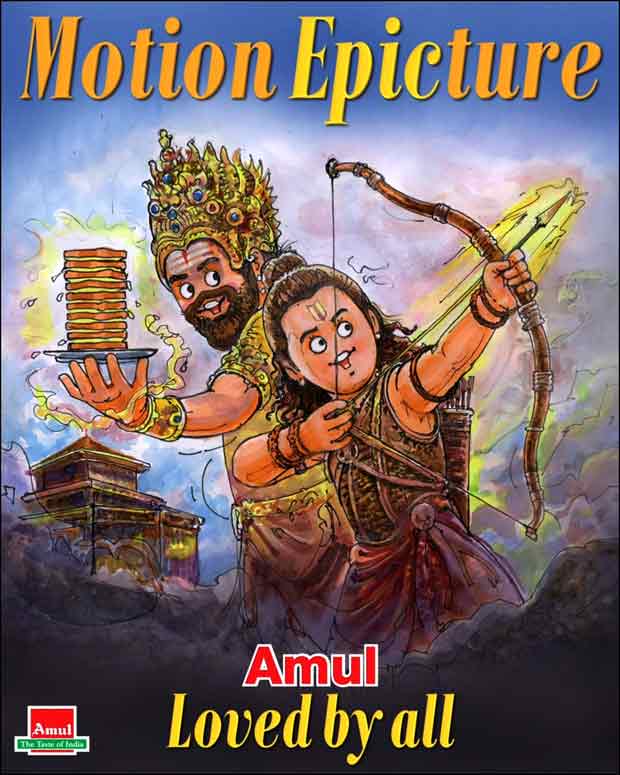
Amul Celebrates Nitesh Tiwari’s Ramayana With a Playful “Motion Epicture” Topical
Amul India has joined the growing conversation around Nitesh Tiwari’s Ramayana, unveiling a witty new topical inspired by the film’s theatrical release. Known for turning major cultural moments into memorable advertisements, the dairy brand has once again combined illustration and wordplay to mark a headline-making Bollywood project.
The artwork centres on the phrase “Motion Epicture”—a playful twist on “motion picture” that brings cinema together with Amul’s familiar food-focused identity. Drawing on the world of the Indian epic while retaining the brand’s signature visual style, the topical offers a light-hearted nod to the film’s scale and big-screen ambitions.

A familiar Amul format meets a major film release
Amul shared the illustration on its official Instagram account, where it quickly became part of the wider social media discussion surrounding Ramayana. The brand’s topical advertisements are a long-running feature of Indian popular culture, often responding to films, public figures, sporting achievements and significant news events with concise captions and instantly recognisable artwork.
That format gives Amul a way to acknowledge a cultural moment without relying on a conventional promotional campaign. The “Motion Epicture” line is the centrepiece of this latest effort: it evokes the cinematic experience while adding the kind of gentle pun that audiences have come to expect from the brand. The result is an advertisement that is both a tribute to the film and a standalone piece of topical humour.
For Ramayana, the timing is notable. The film is among the most closely watched Bollywood projects inspired by Indian mythology, and its theatrical presentation has become a major part of the conversation around its release. Amul’s illustration reflects that anticipation while extending the film’s visibility beyond trailers, interviews and cinema screens.
A large-scale adaptation of an enduring epic
Directed by Nitesh Tiwari, Ramayana is planned as the first instalment of a two-part adaptation of the ancient Indian epic. Its ensemble cast includes Ranbir Kapoor as Lord Rama, Sai Pallavi as Sita, Yash as Ravana, Sunny Deol as Hanuman and Ravi Dubey as Lakshmana. The casting has drawn considerable attention, bringing together performers with varied screen personas for a story familiar to audiences across generations.
Adapting the Ramayana for contemporary cinema involves more than translating a well-known narrative to the screen. The filmmakers must balance the epic’s cultural and spiritual significance with the expectations of a modern theatrical audience. That challenge has helped make the project a subject of discussion well before viewers encounter the complete story in cinemas.
The production has also attracted interest for its technical ambition. Oscar-winning visual effects studio DNEG is associated with the film’s visual effects, while the score brings together A.R. Rahman and Hans Zimmer. The collaboration has added another point of curiosity for moviegoers, particularly those interested in how music, sound and digital effects might contribute to the scale of the adaptation.
Why the Amul topical adds to the buzz
Film promotions increasingly extend across social platforms, brand partnerships and online conversations. In that environment, a topical advertisement can provide a lighter, more shareable way to keep a release in public view. Amul’s approach is distinctive because it does not attempt to explain the film or repeat its official messaging. Instead, it uses a compact visual joke to invite recognition and conversation.
The topical also highlights how mythological stories continue to shape Indian entertainment. The Ramayana has been retold through theatre, television, literature and cinema, with each version reflecting the medium and audience of its time. A large-scale Bollywood adaptation brings its own contemporary filmmaking tools to that tradition, while an Amul illustration offers a much smaller—but culturally familiar—response to the same story.
For audiences, the artwork is another sign of the film’s reach across popular culture. Its presence in brand advertising, online posts and entertainment coverage shows how anticipation for a major release can travel well beyond the cinema industry. Amul’s contribution is brief, but its wordplay gives fans a fresh way to engage with the film’s arrival.
More than a promotional pun
“Motion Epicture” works because it connects two recognisable ideas: the spectacle of a motion picture and Amul’s long-standing association with food. That simple combination keeps the message accessible, while the mythological inspiration gives the illustration a direct link to the film. It is a small example of how familiar brands can participate in a major entertainment moment without overshadowing the project they are celebrating.
As discussion around Nitesh Tiwari’s Ramayana continues, the Amul topical adds a playful note to a release defined by epic source material, a prominent cast and ambitious production elements. For Bollywood followers, it is another reminder that the film’s cultural footprint is being shaped not only by what appears on screen, but also by the conversations and creative responses surrounding it.